

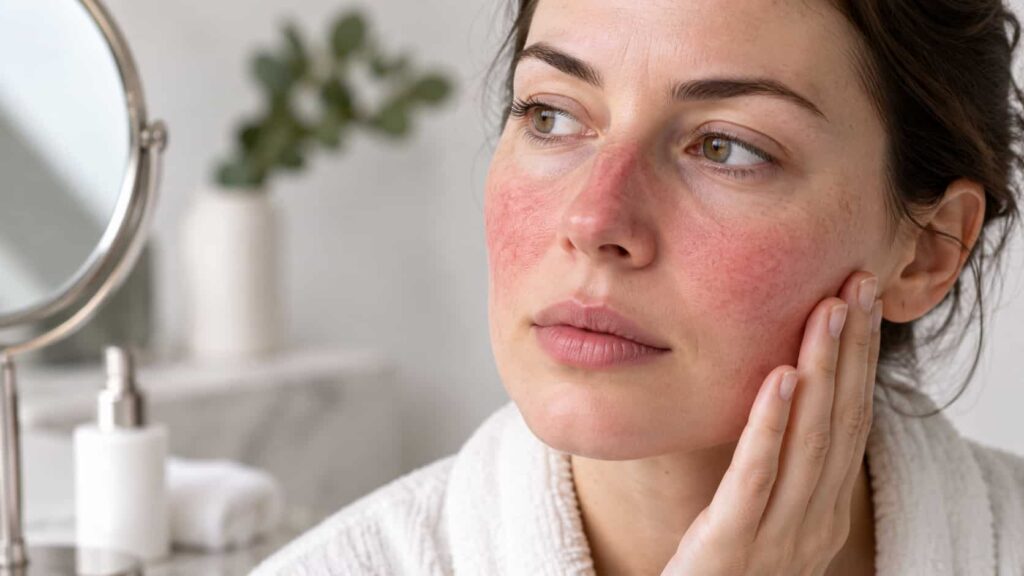
Do your cheeks get red easily?
Do you notice small blood vessels around your nose?
Does your face stay red longer than it used to?
We often hear the terms “redness,” “couperose,” and “rosacea” used to describe these symptoms. However, they do not mean exactly the same thing.
And this distinction is important. Before considering IPL treatment, you first need to understand what’s causing the redness you see on your skin.
Redness is first and foremost a visible sign, not a diagnosis.
The face may temporarily turn red due to heat, cold, physical activity, emotions, or certain products applied to the skin.
In this type of situation, redness may appear and then disappear.
Ce qui attire davantage notre attention, c’est lorsque les rougeurs deviennent fréquentes, persistent ou s’accompagnent d’autres manifestations : petits vaisseaux visibles, sensation de chaleur, picotements ou réactions répétées de la peau.
That’s when it becomes important not to lump all types of redness into the same category.
The term “rosacea” is commonly used to describe small blood vessels visible on the surface of the skin, particularly on the cheeks and around the nose.
They can form thin red lines that are easily visible to the naked eye.
It is, therefore, primarily a visible vascular manifestation.
A person may have visible blood vessels without necessarily concluding on their own that they have rosacea.
Rosacea is a chronic inflammatory skin condition that primarily affects the face.
It can manifest in various ways. Some people mainly experience persistent redness. Others have visible blood vessels, facial flushing, or pimples that can sometimes be mistaken for acne.
Rosacea can also affect the eyes in some people.
This is where the distinction becomes important: seeing red is not enough to determine what is happening in the skin.
When rosacea is suspected or when symptoms go beyond cosmetic concerns, a medical diagnosis is recommended.
Here’s something that’s often overlooked when discussing treatments: what triggers the redness also matters.
For some people, heat triggers a flare-up. For others, it might be the sun, cold weather, a hot drink, alcohol, spicy food, exercise, or even a cosmetic product.
It may therefore be helpful to note not only where your skin turns red, but also when and under what circumstances.
This information helps us better understand what we are observing. It also serves as a reminder that cosmetic treatment can address certain visible symptoms without necessarily eliminating the underlying cause of the redness.
Where can IPL be used?
At Esthétique & Électrolyse Evasion, we use the Harmony XL Pro platform for certain vascular treatments using intense pulsed light (IPL).
IPL can be used, in particular, to target certain visible blood vessels and certain types of vascular redness. The light energy is absorbed by the targeted structures to alter their appearance.
But we don’t assume that “red face = IPL.”
Before treatment, we assess the location of the redness, its appearance, the presence of visible blood vessels, and how the skin reacts. We also want to know whether the redness is constant or whether it occurs mainly in certain situations.
Does IPL cure rosacea?
No. And it’s important to make this distinction clear.
Rosacea is a chronic condition. IPL can be used to improve some of its vascular symptoms, such as visible blood vessels or certain persistent redness, but it does not cure rosacea itself.
Depending on the symptoms present, medical treatment, appropriate care, and a better understanding of the triggers can also be part of managing rosacea.
As with many light-based treatments, exposure to sunlight must be taken into account.
At Esthétique & Électrolyse Evasion, we generally recommend the period from October through spring for our IPL treatments for redness and visible blood vessels. During this time, it’s easier to limit sun exposure and follow the pre- and post-treatment recommendations.
So, before you try to “get rid of your redness,” start by figuring out what kind of redness it is.
Couperose, occasional redness, and rosacea may sometimes look similar in the mirror, but they don’t necessarily tell the same story.
A consultation allows us to assess the visible signs on your skin and determine whether IPL treatment may be appropriate. If a medical condition is suspected, we recommend that you consult a healthcare professional instead.
Esthétique & Électrolyse Evasion
Delson, Quebec
* Required field(s). We collect this data to process your request in accordance with the Privacy Policy, which can be found here: Privacy Policy. You have the right to access, rectify, provide instructions regarding the management of your data after your death, and transfer your data, and, for legitimate reasons, to request its erasure, restriction of processing, and to object to its processing. You can exercise these rights by contacting us here: Privacy Policy.
* Required field. We collect this data to process your request in accordance with our Privacy Policy, which can be found here: Privacy Policy. You have the right to access, rectify, provide instructions regarding the management of your data after your death, and request its portability. For legitimate reasons, you also have the right to erasure, restriction of processing, and objection to the processing of your personal data. To exercise these rights, please contact us here: Privacy Policy.